By: Kenneth Appiah Bani
Donald J. Trump has threatened to impose significantly higher United States tariffs on the European Union if the bloc fails to reduce its tariffs to zero by July 4, following a high-level phone conversation with Ursula von der Leyen.
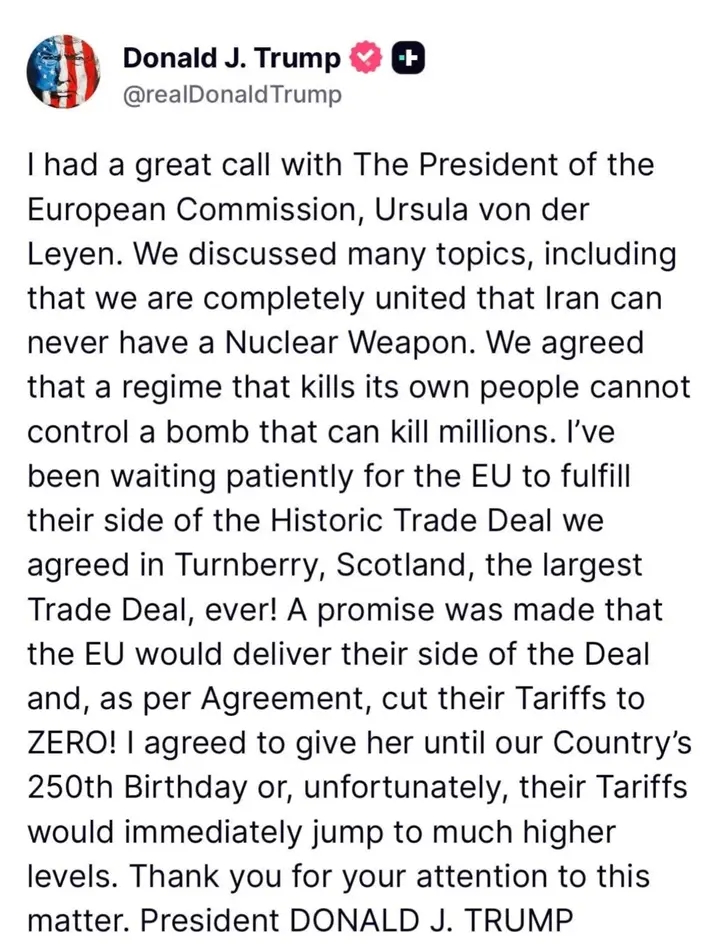
In a statement shared on social media, President Trump revealed that he held what he described as a “great call” with the European Commission President, during which both leaders discussed trade relations and international security concerns, particularly Iran’s nuclear ambitions.
According to Trump, the two leaders agreed that Iran should never be allowed to obtain nuclear weapons.
“We are completely united that Iran can never have a Nuclear Weapon,” Trump stated. “We agreed that a regime that kills its own people cannot control a bomb that can kill millions.”
Beyond security matters, Trump turned attention to trade tensions between Washington and Brussels, accusing the European Union of failing to fulfill its obligations under what he called a “historic trade deal” reached in Turnberry, Scotland.
The U.S. President said the agreement included a commitment by the EU to reduce tariffs to zero, warning that failure to meet that commitment by America’s 250th Independence Anniversary on July 4 would trigger an immediate increase in U.S. tariffs on European goods.
“I’ve been waiting patiently for the EU to fulfill their side of the Historic Trade Deal,” Trump said. “A promise was made that the EU would deliver their side of the Deal and, as per Agreement, cut their Tariffs to ZERO.”
Trump further cautioned that if the European Union does not comply within the stated timeframe, tariffs on EU imports into the United States would “immediately jump to much higher levels.”
The remarks are expected to heighten tensions between the United States and the European Union at a time when global trade and geopolitical security remain key international concerns.
Observers say any escalation in tariff measures could have significant economic implications for transatlantic trade, affecting industries ranging from manufacturing to agriculture and technology.