
By Kenneth Appiah Bani
The relationship between Ghanaian highlife musician Fameye and music executive Ogidi Brown, founder of OGB Music, was once seen as a promising partnership that could produce major success in Ghana’s music industry. However, what began as a professional relationship eventually turned into a bitter dispute involving money, contracts, music ownership and broken ambitions.
Fameye reportedly joined OGB Music in 2018 under a five-year agreement. During his time with the label, he recorded songs that contributed significantly to his rise in the Ghanaian music scene, including the widely known hit “Nothing I Get.”
However, by 2020, the relationship between the artiste and his manager had reportedly become strained. Claims of disagreements and a physical confrontation between the two also emerged, alongside allegations concerning money invested in Fameye’s career.
The disagreement became more public in December 2020 when Ogidi Brown accused Fameye of owing him $50,000, which he said was part of an agreement reached during Fameye’s exit from OGB Music.
Frustrated by what he described as delays in receiving the money, Ogidi Brown publicly expressed his anger and at one point threatened to resort to traditional spiritual means at the Antoa shrine to settle the matter.
The controversy attracted considerable attention from fans and industry observers, further exposing the tensions between the two former business partners.
In July 2021, Fameye and OGB Music announced their separation.
At the time, Fameye expressed appreciation for the opportunities and support he received while working with Ogidi Brown and described the separation as amicable.
However, the apparent end of their formal relationship did not completely bring an end to the disagreements between them.
Over the years, both parties have continued to make statements about unresolved issues surrounding their former business relationship.
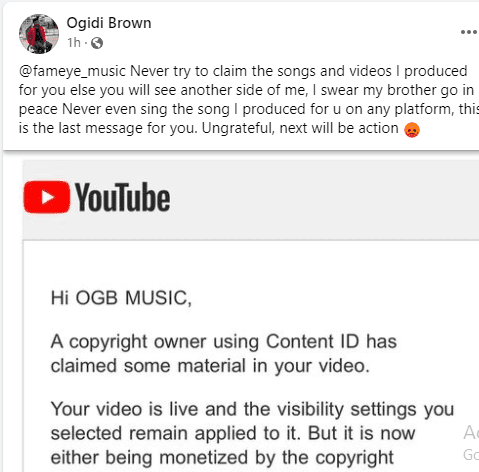
The conflict resurfaced again when Ogidi Brown reportedly received notifications that some songs associated with OGB Music, including “Nothing I Get,” “Destiny” and “Nobody Dey,” had been flagged for copyright infringement on YouTube and digital music platforms.
According to Ogidi Brown, further investigation led him to believe that Fameye had reported the songs, allegedly claiming ownership of the works.
The development reignited the debate over who legally owns the songs and the rights attached to music released during Fameye’s time with OGB Music.
Ogidi Brown subsequently took to social media to express his frustration over the situation, arguing that the songs were produced during Fameye’s time under his record label.
Because ownership and copyright claims can depend heavily on contracts, registrations and other legal documents, the competing claims remain a matter of dispute between the two parties.
The financial disagreement resurfaced during Fameye’s recent appearance on The Delay Show, where he was asked whether he had completely paid the $50,000 reportedly owed to his former boss.
Fameye responded that he had paid the full amount and claimed that he had even paid more than the amount in question.
Ogidi Brown, however, later released a video disputing Fameye’s account. He maintained that Fameye had only paid part of the money and insisted that the entire amount had not been settled.
The conflicting accounts have once again placed the financial aspect of their former relationship in the spotlight.
In a phone interview with Twig Multimedia, Ogidi Brown provided further details about his experience managing Fameye.
He explained that while Fameye was signed to OGB Music, he tried to maintain transparency regarding revenue generated from digital platforms and YouTube.
According to Ogidi Brown, his management team handled Fameye’s shows at the time. He claimed, however, that disagreements arose when an international performance opportunity came up and Fameye wanted to determine the fee for the foreign engagement himself.
Ogidi Brown suggested that disagreements over management, finances and the handling of opportunities contributed to the deterioration of their relationship.
Beyond the dispute with Fameye, Ogidi Brown claimed that the experience had a significant impact on his passion for artist management.
He said the difficulties surrounding his relationship with Fameye affected his motivation to continue building OGB Music and ultimately caused him to miss opportunities to work with other emerging talents.
Among the artistes he mentioned were Black Sherif, Kweku Flick and King Paluta.
Ogidi Brown claimed that Kweku Flick was among the artistes he seriously considered signing and that paperwork had reportedly been completed, although he remained undecided about finalising the deal.
He further alleged that members of Black Sherif’s family personally contacted him and encouraged him to sign the young artiste.
According to Ogidi Brown, however, his experience with Fameye had left him discouraged and uncertain about continuing with artist management.
Ogidi Brown has described his ambition for OGB Music as much bigger than managing one successful artiste.
He said his dream was to build a powerful record label capable of signing and developing a large number of Ghana’s most promising young talents.
In his account, the fallout with Fameye significantly affected that vision.
What was once a promising relationship between an emerging artiste and a music executive therefore evolved into a dispute that has continued to generate public discussion years after their official separation.
The Fameye-Ogidi Brown saga illustrates some of the challenges that can arise when artistes and record labels disagree over contracts, finances, music ownership and management responsibilities.
Although the two formally parted ways in 2021, subsequent disagreements over money and ownership of songs have continued to keep their former relationship in the public eye.
At the centre of the dispute are competing accounts: Fameye maintains that he settled the financial obligation, while Ogidi Brown says only part of the money was paid. Similarly, questions surrounding ownership and rights to songs released during Fameye’s OGB Music era remain contentious.
For now, the public continues to hear different sides of the story from the two former business partners.
What is clear, however, is that the OGB Music chapter in Fameye’s career produced both significant musical success and a business relationship that ultimately ended in bitterness.
Disclaimer: This article reflects claims and statements attributed to Fameye and Ogidi Brown. Allegations concerning payments, contractual obligations and copyright ownership should not be treated as established facts unless supported by relevant agreements, records or a competent legal determination.