By: Kenneth Appiah Bani
Immigration authorities at OR Tambo International Airport in South Africa have disclosed that only 10 out of approximately 300 Ghanaians who presented themselves for evacuation were found to be residing legally in the country.
The revelation comes amid ongoing efforts by the Ghanaian government to repatriate citizens following heightened xenophobic tensions and growing safety concerns in parts of South Africa.
Speaking to reporters, Head of Immigration and Law Enforcement at South Africa’s Department of Home Affairs, Stephen van Neel, said investigations uncovered widespread immigration violations among the group.
“Of the 300 individuals that were on that list, we only found 10 of them to be legal in the country,” van Neel stated.
“We obviously have to make sure that certain sanctions are enforced.”
South African authorities indicated that the situation may require enforcement measures as investigations into the immigration status of the affected individuals continue.
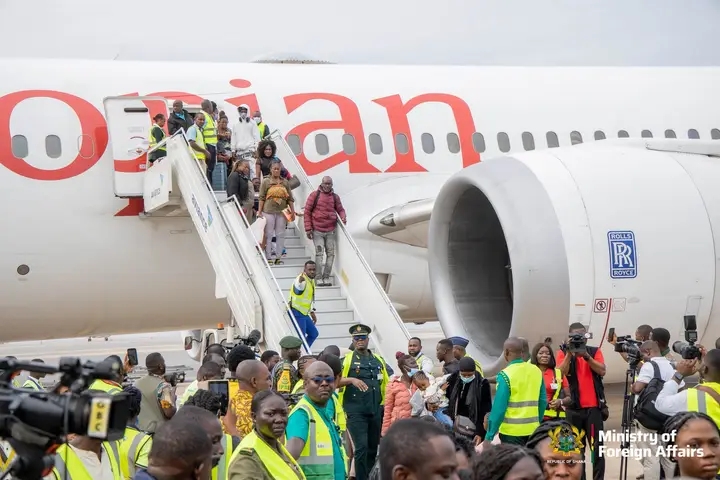
The first batch of Ghanaian returnees departed South Africa on Wednesday as part of a voluntary repatriation programme coordinated by the Government of Ghana.
Ghana’s High Commissioner to South Africa, Mr. Benjamin Quashie, confirmed that more than 800 Ghanaians had registered for voluntary repatriation amid fears triggered by renewed xenophobic tensions.
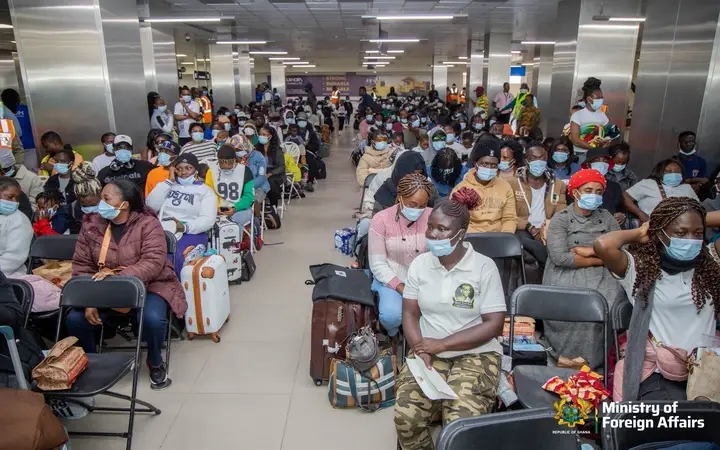
According to him, many of the evacuees were not directly attacked but decided to return home over concerns about their personal safety.
“The responsibility of any government is towards its citizens,” Mr. Quashie said.
“While we have excellent relations with South Africa, we had no option but to ensure that our citizens are safe.”
Ghana’s Minister for Foreign Affairs, Samuel Okudzeto Ablakwa, announced on May 18 that the government would facilitate the repatriation exercise, which officially began on May 25.
As part of support measures for the returnees, the government pledged transportation assistance to destinations across Ghana, reintegration allowances, psychosocial support, and opportunities for inclusion in a national database for employment and start-up support programmes.
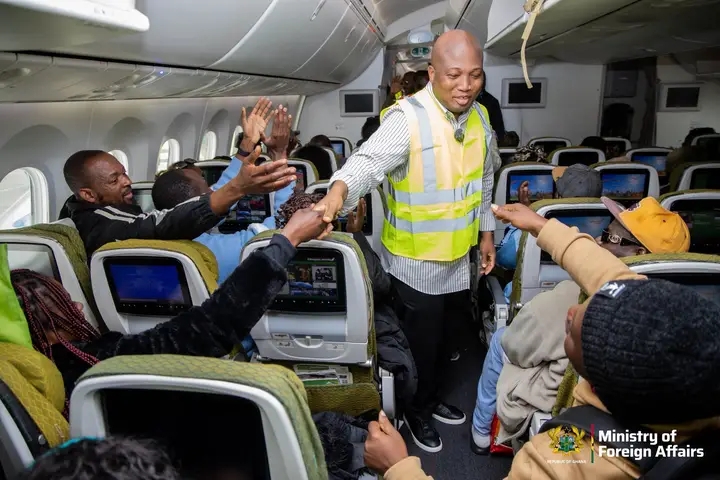
Meanwhile, Ghana’s Chief of Staff, Julius Debrah, together with Foreign Affairs Minister Samuel Okudzeto Ablakwa, welcomed the first batch of evacuees upon their arrival at the Accra International Airport on Wednesday, May 27.
The government delegation also supervised the initial reintegration process for the returnees.
Addressing the evacuees, Mr. Debrah encouraged them to remain hopeful despite the difficult circumstances surrounding their return.
“Most importantly, we want to encourage our brothers and sisters that once they are back, they should be very optimistic and hopeful about the future,” he said.
“Sometimes God has different ways of opening new doors for us. As a nation, we shall always stand by our people, no matter where you find yourself. Be encouraged, and believe that it shall all end well.”
Several returnees also shared emotional accounts of the hardships they endured in South Africa before their evacuation.
One returnee, who had previously been incarcerated in South Africa, confirmed upon arrival in Ghana that all 26 Ghanaians who had been detained there had now been successfully evacuated.
Another victim of the xenophobic violence recounted how he was forced to abandon a thriving barbering business to save his life.
“I owned a 40-foot container barbering salon in South Africa, but because of the situation, I had to run for my life,” he said.
A different evacuee described the impact the tensions had on foreign families and children.
“Even my children are unable to attend school because the moment they are identified as foreigners, they are driven away,” the victim recounted.
Another returnee narrated what he described as inhumane treatment he suffered after attempting to stop a vehicle theft incident.
“I went through this inhumane treatment simply because I attempted to stop someone’s vehicle from being stolen,” he said.
The testimonies from the evacuees highlight the growing fear and uncertainty many foreign nationals have faced amid renewed xenophobic tensions in parts of South Africa, prompting hundreds of Ghanaians to voluntarily return home under the government’s evacuation programme.